Roles of Giant Cluster in Innovation

Samsung_GiantCluster_new

Roles of Giant Clusters in Knowledge Diffusion and Recombination

Sungyong Chang,

Columbia Business School, Columbia University

Jeho Lee and Jaeyong Song

 Graduate School of Business, Seoul National University

[SSRN Working Paper Version]

Abstract

      In this paper, the inventor collaboration networks in the semiconductor division of Samsung are examined during the period from 1982 to 2006. The data analysis demonstrates that in the beginning, the collaboration networks were made up of unconnected small clusters corresponding to subunits. In the 1990s and onwards, a giant cluster made up of bridges connecting previously unrelated small- and medium-sized clusters emerged. However, hubs or extremely well-connected individuals are absent. To identify the role of the giant cluster in facilitating innovation, we develop computational models. Two roles are identified: knowledge integrator and knowledge reservoir. The giant cluster acts as a knowledge integrator by facilitating knowledge diffusion between previously unconnected clusters. As the cluster grows and more ties are formed, knowledge diffusion increases monotonically. However, in the case of knowledge recombination, performance does not increase monotonically with additional bridges. With too many bridges or hubs, knowledge recombination performance declines because giant clusters cannot keep diverse knowledge for future use—i.e., it is unable to play a role of knowledge reservoir. We find that only giant clusters with a modest proportion of bridges can act as a knowledge reservoir and facilitate innovation by better preserving diverse knowledge.

Key words: Network; Knowledge; Evolution; Innovation

World Firm Size Distribution and A Test of Gibrat’s Law

World Firm Size Distribution and A Test of Gibrat’s Law

Sungyong Chang

Columbia Business School, Columbia University

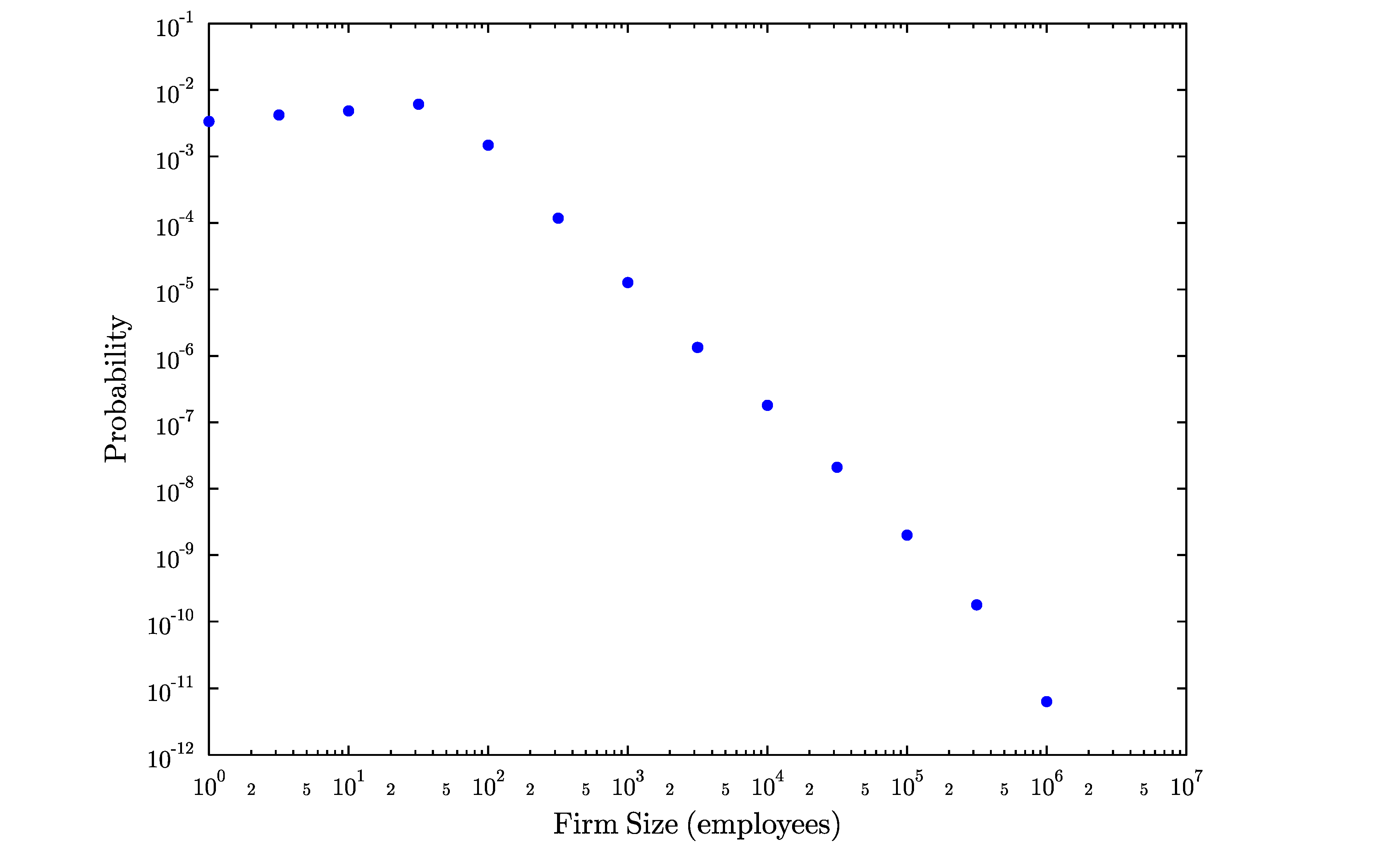
This paper explores world firm size distributions and firm growth processes. There have been disputes on what would be the underlying mechanism that generates skewed firm size distributions. Some scholars believe that the random stochastic growth process, Gibrat’s law, generates skewed firm size distributions in the real world. However, other scholars believe that systematic factors affect firm growth rates and firm size distributions. This paper investigates the world firm size distribution and tests Gibrat’s law by analyzing the Orbis database which covers over 44 million firms around the world. The first finding is that the world firms size distributions follow the Pareto distribution, also known as a power-law distribution. The second finding is that there exist (1) size-growth rate correlations and (2) serial correlations in firm growth rates. Both are small and negative, but statistically significant. To investigate the effects of size-growth rate correlations and serial correlations in firm growth rates on firm size distributions, we build a computational model based on Gibrat’s law. The results from the computational model show that the random stochastic growth process, Gibrat’s law, generates the Pareto distributed firm sizes, even under the empirical size-growth rate correlations and serial correlations in firm growth rates. Finally, we discuss the role of randomness in generating systematic patterns at the macro level.

Figure 1. World Firm Size Distribution in 2011

figure1