Understanding the Borders of Network Effects in Global Markets

(Based on the coauthored work with Sanghyun Park, National University of Singapore – SSRN working paper version)

In today’s interconnected digital economy, firms face unique challenges and opportunities as they expand internationally. While first-mover advantages are well-recognized, our research delves into how cross-country ties and network structures shape the early internationalization strategies of latecomers in global markets.

Breaking Down Network Effects

Network effects occur when a product or service becomes more valuable as more people use it. This concept is especially powerful in digital industries, such as mobile instant messaging (MIM), where user interaction drives adoption. However, network effects don’t always result in global dominance for first movers. In fragmented markets with limited cross-border connections, latecomers can thrive by strategically entering untapped regions.

The Role of Cross-Country Ties

Our computational model highlights the importance of “bridges,” or connections between customer networks in different countries. Sparse cross-country ties can limit the spillover of network effects from one country to another. For example, Naver Line, a latecomer in South Korea’s MIM market, leveraged this fragmentation to dominate the Japanese market, avoiding head-to-head competition with South Korea’s leader, KakaoTalk.

Strategic Dilemmas for Latecomers

Latecomers face a trade-off:

  • Survival Strategy: Early internationalization in fragmented markets can ensure survival by avoiding competition in saturated domestic markets.
  • Dominance Challenge: However, focusing on survival might hinder their ability to achieve global leadership, especially in well-connected markets where first movers can capitalize on strong network effects.

Implications for Digital Firms

Understanding the structure of social networks and the level of cross-country ties is crucial for firms navigating global markets. By considering these demand-side factors, latecomers can craft strategies that balance survivability with the potential for market dominance.

Our findings underscore the nuanced dynamics of global competition in the digital age. Whether a firm is a first mover or a latecomer, success hinges on adapting to the intricate interplay of network structures and consumer behaviors.

The Hidden Side of Pay Transparency: How Salary Ranges Shape Gender Dynamics in the Workplace

Alice J. Lee (Cornell), Tae-Youn Park (SKKU), Sungyong Chang (Cornell)

In recent years, pay transparency laws have gained traction as a tool to combat gender pay gaps and promote equity. However, as one of my working papers reveals, not all transparency initiatives yield the expected results. This research delves into the nuanced effects of pay range transparency on job application preferences and salary negotiations, particularly between men and women.

The Promise and Peril of Pay Range Transparency

Pay range transparency requires employers to disclose a salary range for job postings, ostensibly to empower candidates with more information. However, the study highlights an unintended consequence: women tend to prefer narrower pay ranges compared to men. This preference, rooted in higher risk aversion, could have ripple effects on negotiation assertiveness and long-term earning potential.

Key Findings

1. Pay Range Size and Gendered Application Behavior: Across four studies, the researchers found that women are significantly more likely than men to apply for jobs with narrower pay ranges. This preference is shaped by women’s general tendency towards risk aversion.

2. Negotiation Dynamics: The narrower the pay range, the less assertive the negotiation behaviors observed. Women, who often opt for narrower ranges, may negotiate less aggressively, leading to potentially lower salary outcomes.

3. Organizational Gender Representation: Firms that advertise wider pay ranges tend to have fewer female employees. This suggests that pay range policies might influence not just individual outcomes but also organizational diversity.

Implications for Policy and Practice

While pay transparency is a step toward equity, these findings underscore the importance of considering how information is presented. Policymakers and organizations should aim for balance: providing transparency while mitigating the unintended effects of perceived risk and uncertainty. For instance, guidelines on optimal pay range sizes or accompanying transparency efforts with negotiation training for women could help bridge the gap.

Looking Forward

As the conversation around pay equity evolves, it’s crucial to examine how well-intentioned policies interact with human behavior. This research serves as a reminder that the path to equity requires both data transparency and thoughtful implementation.

What are your thoughts on pay transparency? Could these findings shape how your organization approaches salary disclosures? Let’s discuss!

How Do Investors Shape Startups’ Response to New Market Opportunities? Evidence from the TCGA in the Oncology Market

Sarath Balachandran

London Business School

Sungyong Chang

Johnson Graduate School of Management, Cornell University

Sukhun Kang

University of California Santa Barbara

[Link to the Working Paper Version on SSRN]

Startups often face a challenging decision: should they redirect resources to pursue emerging opportunities, or should they stay focused on their ongoing efforts? This choice can significantly impact their growth and success. Our recent study explores the critical role venture capital (VC) investors play in guiding these decisions.

The Role of Venture Capital Investors

Venture capital investors do more than just provide funding—they influence strategic decisions, especially when new market opportunities arise. We examined this dynamic using a unique natural experiment: the staggered release of data from The Cancer Genome Atlas (TCGA), which mapped genetic mutations across various cancers. Occasionally, the release of TCGA data for one cancer type revealed genetic links to others, presenting startups with unexpected opportunities to develop new treatments.

Key Findings

1. Timing of Funding Matters: Startups were more likely to seize new opportunities shortly after receiving a funding round. This period is when they are least constrained by resources, allowing them to explore new markets more freely. As time passes and resources dwindle, startups become less inclined to take on new projects.

2. Investor Knowledge Networks Boost Responsiveness: Startups were more responsive to new opportunities when their investors had other portfolio companies with experience in the emerging market. This connection provided a channel for knowledge transfer, giving startups an edge. This effect was particularly pronounced for startups located outside major oncology hubs, where access to specialized knowledge is more limited.

3. Short-Term Focus from Investors Can Limit Flexibility: Startups with investors under pressure to achieve short-term exits were less likely to pursue new market opportunities. These investors tended to encourage a narrower focus, prioritizing near-term gains over longer-term exploration. This suggests that while investors can enable startups to pivot and expand, they can also impose constraints when under pressure to deliver quick returns.

Implications for Entrepreneurs and Investors

Our findings highlight the dual role of venture capital investors as both enablers and constraints in startup strategy. Entrepreneurs should be aware of how their funding timing and the nature of their investors can shape their ability to pursue new opportunities. Meanwhile, investors can reflect on how their pressure for short-term returns might limit the strategic flexibility of their portfolio companies.

This study contributes to a deeper understanding of how external stakeholders influence startup strategy, particularly in dynamic, high-stakes fields like oncology. As the startup ecosystem continues to evolve, recognizing these dynamics can help both founders and investors make more informed decisions.

Does the Motivation for Distant Search Stem from Capabilities or Incentives? Evidence from the Wildcatters in the Petroleum Industry

Divya Saxena (Tilburg), Sungyong Chang (Cornell), Sendil Ethiraj (LBS)

Abstract


The difficulty of distant search and radical innovation for incumbent firms is a well-accepted assertion in the literature, primarily attributed to cannibalization risk and capability-driven inertia. This study explores the under-theorized role of capabilities in enabling distant search, independent of incentives. We examine the search behavior of firms in the U.S. oil exploration industry from 2008 to 2018, analyzing data from over 940,000 lease lands and drilling outcomes by 25,033 firms. Our findings indicate that, controlling for incentives, firms specializing in distant search are more successful, facing a lower likelihood of drilling dry holes compared to those focusing on local search. We identify key mechanisms underpinning distant search capabilities, including the use of trade secrets and the accumulation of experiential knowledge. Contrary to the notion that only incentives drive distant search, our results highlight the significant role of capabilities. This study contributes to the literature by providing empirical evidence that challenges the conventional understanding of organizational search behavior and by identifying specific capabilities that facilitate distant search, thereby informing managerial strategies and policy decisions to foster innovation.

Keywords: Distant search, Incumbent firms, Incentives view, Capabilities view, Oil Exploration Industry

ARTIFICIAL INTELLIGENCE AND ORGANIZATION MODELING

Sungyong Chang

Under Review at Oxford Bibliographies [invited manuscript]

Abstract/Introduction

Artificial intelligence (AI) has significantly influenced organizational modeling, evolving from the early days of understanding collective intelligence within organizations with bounded rationality to the contemporary use of neural networks and deep learning. Tracing its roots back to Herbert Simon’s work on administrative behavior and complex adaptive systems, AI’s journey in organizational studies has shifted from a focus on explicit decision rules to connectionist approaches akin to neural networks. This transformation is highlighted by the rise of computational power and extensive digital datasets, enabling advanced deep learning systems. However, the application of these AI advancements in organizational design remains in its nascent stages. The potential of AI as a tool and metaphor for organizational design raises crucial questions about its role in framing human decision-making and the challenges of integrating atheoretical AI systems with human cognition.

Reexamination of Ownership Structure and R&D Investment in Family Businesses: Evidence from Korean Business Groups

Reexamination of Ownership Structure and R&D Investment in Family Businesses: Evidence and Insights from Korean Business Groups

Abstract

The study reexamines the family ownership and overall firms’ ownership structure on R&D investment, as these vary significantly between companies. Both variables are endogenous, necessitating an analysis that accounts for this endogeneity. The findings indicate that the impact of professional management shareholding on R&D investment is not significant, and vice versa. It reveals a tendency for R&D investment to decrease as the family owner’s shareholding increases, and firms with higher R&D investments tend to have lower owner shareholdings. The passage also notes that empirical research results often conflict, and this study highlights that differences in econometric methods could contribute to these conflicting results.

Keywords:

Key Word: Family Business, Ownership Structure, Family Ownership, R&D Investment, Instrumental variable analysis, Hausman & Taylor IV/GLS

When Do Firms Provide Early Access? Evidence from Expanded Access in the Oncology Drug Market, 1990-2020

When Do Firms Provide Early Access?
Evidence from Expanded Access in the Oncology Drug Market, 1990-2020

[AOM Proceeding version]

Abstract

While a growing number of firms provide early access to their innovative products before commercialization (i.e., before developing a full-blown product), we have a limited understanding of providing early access. We take an early step to explore when and why some firms are more likely to provide early access than others. On the one hand, early access could allow potential customers to learn about products before commercialization, speeding up the entry timing. On the other hand, products that are under the R&D process have more technological uncertainties than fully-developed products. We investigate three factors that can affect the balance between benefits from early entry and costs from greater uncertainties in the context of the oncology drug market 1990-2020. First, we argue that entrepreneurial firms will be less likely to provide early access because they are more likely to lack the required resources for deploying early access. Second, we argue that firms will be less likely to provide early access to a first-mover product than a latecomer product because a first-mover product tends to bear more uncertainties than a latecomer product. Third, we argue that firms will be more likely to provide early access to products if they receive a regulatory certification because receiving such certification eases uncertainties perceived by consumers. Our empirical analysis provides supporting evidence for our key arguments.

Keywords: Early Access, Uncertainty, Competition, Regulatory Certification, Entrepreneurial firms, Complementary assets

Role of Latecomers’ Imitation in Overtaking Industry Leaders: A Resource Allocation and Building Perspective

Role of latecomers’ imitation in overtaking industry leaders: A resource allocation and building perspective [Link to SSRN]

Abstract

Since Schumpeter emphasized the importance of innovation for latecomers to leapfrog and overtake industry leaders, strategy research has viewed innovation as the primary impetus for leadership change. On the other hand, imitation in this literature has been portrayed as a strategy by which a latecomer can narrow the gap with, but not surpass, leaders. Thus far, little research has examined whether imitation can help latecomers with disadvantageous positions catch up with and eventually overtake leaders. By employing a computational model, we find that latecomers who pursue innovation alone are unlikely to overtake leaders, whereas latecomers who mix innovation and imitation are more likely to do so. When the latecomer allocates all its R&D budget to innovative R&D, it is likely to run out of capital quickly and be unable to continue to invest in R&D. A mix of innovation and imitation better maintains a steady cash stream, helping the latecomer continue to invest in R&D and thereby leaving room for leapfrogging opportunities.

Keywords: Schumpeterian competition, imitation, innovation, technological leadership change, difficulty of innovation

Industry Cyclicality and Entrepreneurial Firms’ Resource Allocation Strategy: Evidence from the DRAM Industry 2005-2014

Industry Cyclicality and entrepreneurial firms’ resource allocation strategy: Evidence from the DRAM industry 2005-2014

[AOM Proceedings Version]

Abstract

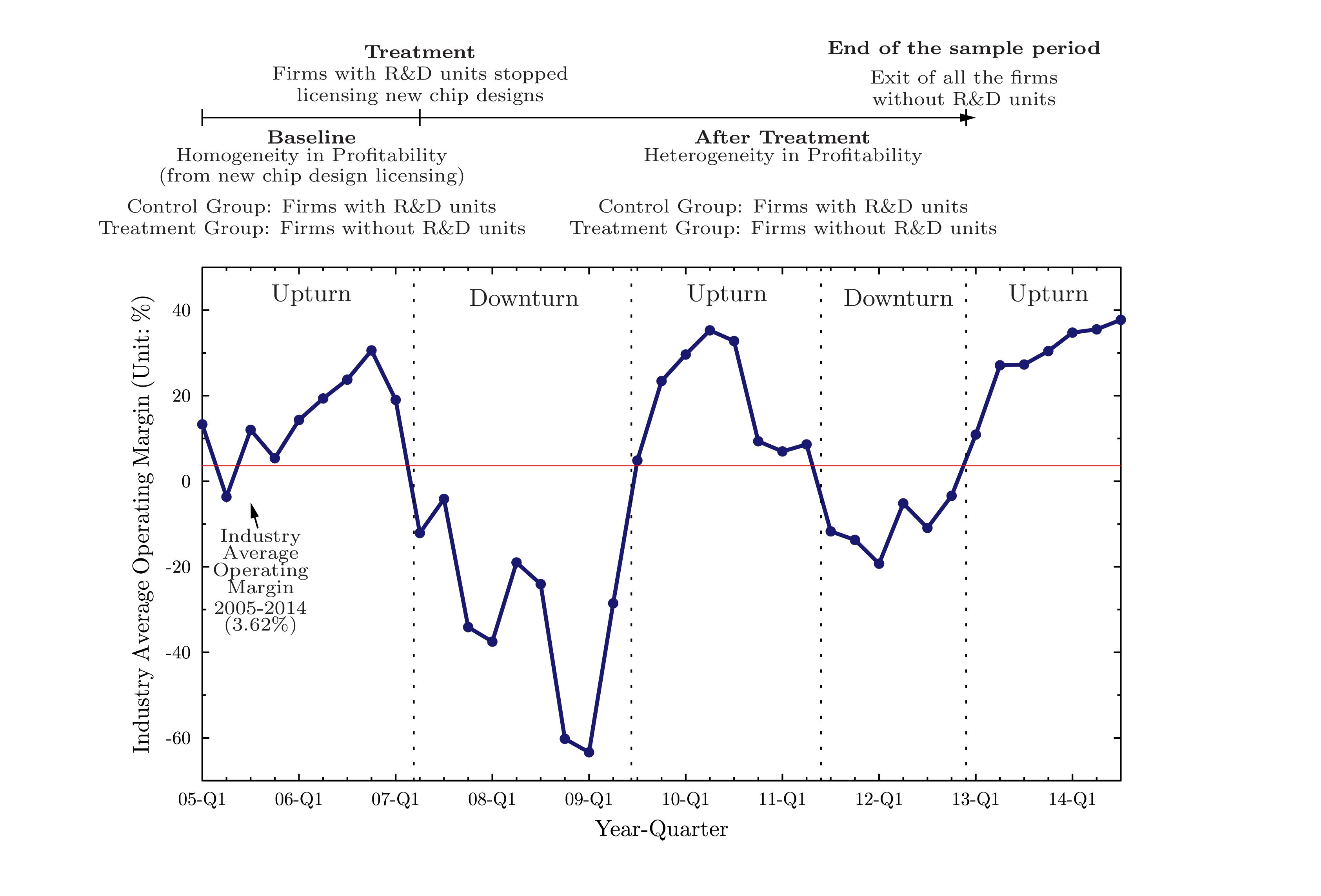
Does toolkit license from incumbents facilitate the survival and growth of the latecomers? We argue that if industry cyclicality exists, toolkit licensing is detrimental to the survival of latecomers as well as low-performing incumbents. The DRAM industry, which is known as a cyclical industry, offers an unusual setting to test these competing hypotheses. During the period 2005-2014, Taiwanese companies experimented with a new business model, the DRAM foundry without an R&D unit. Since all these companies could not license new chip designs during the 2007-2009 downturn of the silicon cycle, we examine how an exogenous reduction of R\&D units during this period influenced firm-level performance. Using all the DRAM manufacturers’ profitability and technology data from iSuppli, DRAMExchange, and SEMI databases, we find that during a downturn, the void of the R&D units led to dramatically low profitability (-84%), which came from low systemic innovation which bridges product innovation and process innovation. The results highlight that the importance of product innovation may not decrease in a fast-changing technological environment.

Keyword: Schumpeterian competition, resource allocation, toolkit licensing, industry cyclicality, DRAM industry

2015-06-25-figure1_cycle

The Impact of Decomposability on Organizational Hierarchy in Entrepreneurial Firms: Evidence from the Game Engine and Video Game Industry 1990-2019

The Impact of Decomposability on Organizational Hierarchy: Evidence from the Game Engine and Video Game Industry 1990-2019

Abstract

We observe a growing number of software development kits (SDKs) are externally available. We explore how using externally available SDKs affects the product innovation process. We characterize (1) product development by using externally available SDKs as solving nearly modular problems and (2) product development by building inhouse SDKs as solving an integral problem (i.e., relatively non-modular). We explore the video game industry, in which software development kits are called game engines, and game developers explore theme innovations (i.e., non-technological dimension) as well as technological innovations. Findings suggest that on average, using commercial game engines facilitates module-level innovations but less likely to introduce system-level innovations which require a cross-module coordination. Also, the number of commercial game engine users is an important predictor of product innovation. If when the number of users is not sufficiently large, its weakness in system-level innovations exacerbated, and the strength in module innovation is also weaker, showing that harnessing the power of positive feedback (i.e., ecosystem effect) between the number of users and the quality of engines matters.

Keywords: Decomposability, Organizational Hierarchy, Software Development Kits, Product Innovation